Ignition Interlock Device Program Illinois BAIID
 11/21/2026

A DUI arrest hits differently when a commercial driver’s license is on the line. In Illinois, a commercial driver can lose the right to drive for a living over a blood alcohol level that would not even trigger a charge for someone in a personal vehicle.
Ktenas Law is staffed by former Cook County and Will County prosecutors who now defend CDL holders in the same Cook and Will County courtrooms where they used to prosecute cases, and this page focuses only on the rules unique to a commercial license, not the general DUI information written for personal drivers.

The limit is cut in half for commercial drivers, and one offense can cost a CDL for a year. Illinois treats a commercial driver as impaired at 0.04, not 0.08, under 625 ILCS 5/6-514. A first violation carries a disqualification of at least 12 months, and at least 3 years if hazardous materials were involved.
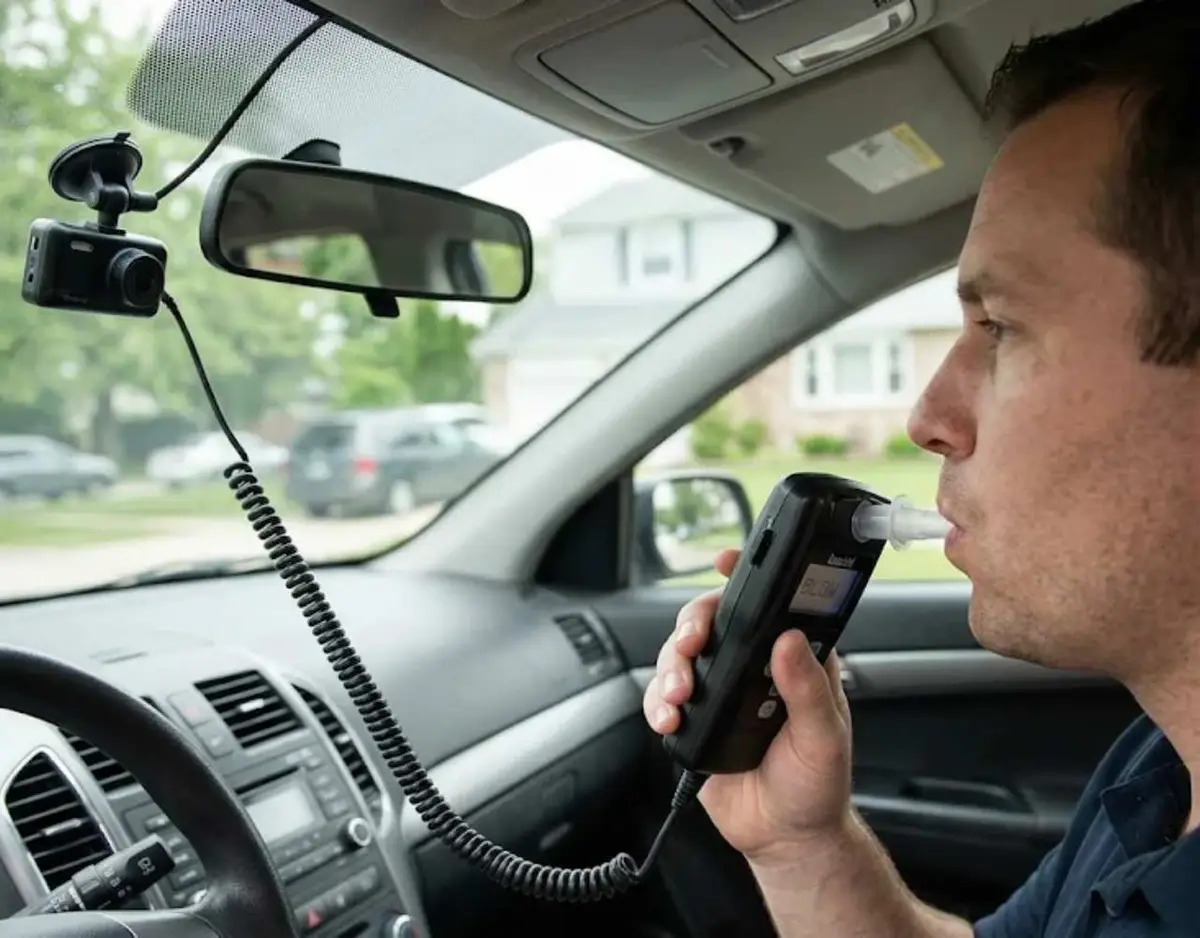
The short version: the legal limit is cut in half for anyone driving a commercial motor vehicle, and even a first offense can take a CDL away for a full year. Under 625 ILCS 5/6-514(opens in a new tab), a commercial driver operating a commercial motor vehicle (CMV) is legally impaired at a blood alcohol concentration of 0.04%, compared to the 0.08% limit that applies to everyone else. That 1-year minimum disqualification applies to a first offense whether the arrest happened in a commercial vehicle or the driver’s own car. Hauling placarded hazardous materials at the time raises the first-offense disqualification to a 3-year minimum. A second DUI or test refusal, in any combination and in any vehicle, results in a lifetime disqualification. None of these penalties depend on winning or losing supervision on the underlying criminal charge, and none of them come with a hardship license or restricted permit for commercial driving.
This is an administrative action by the Illinois Secretary of State, separate from whatever happens in the criminal case. It can attach based on a failed or refused chemical test alone, before a criminal court ever rules on guilt.
A CDL holder does not get a pass just because they were driving their own car that night. Illinois applies the 0.04% threshold to anyone operating a CMV, and separately applies the standard 0.08% threshold (or a refusal finding) to a CDL holder’s personal driving, with the same 1-year CDL consequence attached either way under the law. A driver who would not be over the legal limit in a passenger car can still be over it behind the wheel of a truck, and a driver who is arrested for DUI in their own sedan on a weekend can still lose commercial driving privileges from that arrest alone.
Two or three drinks over a long dinner can put a 0.04% reading within reach for some drivers, which is part of why this threshold surprises people who assume the usual 0.08% applies to them.
The disqualification follows you even when the arrest happened in your own car on your own time. Our CDL DUI defense page explains how the two tracks run.
These are the CDL-specific consequences under Illinois law, on top of whatever penalty a court imposes for the DUI charge itself:
Federal rule permits a state to reinstate a lifetime disqualification after 10 years if the driver completes an approved rehabilitation program, but adopting that path is optional for each state. Whether Illinois currently runs an approved reinstatement program needs attorney confirmation before this page states it as available here. Until that is confirmed, the safer statement is that a lifetime disqualification is treated as permanent in practice for the large majority of Illinois CDL holders.
The DUI charge itself still carries the standard criminal penalties on top of the CDL consequences: a first offense is a Class A misdemeanor carrying up to 364 days in county jail and a fine of up to $2,500 under 730 ILCS 5/5-4.5-55(opens in a new tab), before any CDL disqualification is added on.

A CDL DUI arrest opens two separate cases that run on different clocks. The criminal case moves through Cook County or Will County circuit court and decides guilt or innocence. Separately, the Secretary of State’s office pursues an administrative statutory summary suspension of the driver’s base license under the law, and that suspension automatically takes effect on the 46th day after the arrest notice, regardless of what happens in court. The CDL disqualification is tied to that same administrative process, which is why it can attach even if the criminal DUI charge never results in a conviction.
A driver can challenge the administrative suspension by filing a petition to rescind, and Illinois law gives the driver a right to a hearing on that petition within 30 days of filing it. That is a real deadline, not a suggestion, and Illinois courts have rescinded suspensions where the state failed to hold the hearing in time.
Court supervision on the criminal DUI charge is worth understanding here too. Supervision can keep a conviction off a driver’s personal record for most purposes, but federal CDL rules define “conviction” broadly enough to include dispositions like supervision that involve a fine or court costs. In practice, that means supervision on the criminal case does not reliably protect a CDL from disqualification, and a driver should not assume it will.
Nothing here promises a dismissal or a reduced charge. What a careful review can do is test whether the stop, the testing, and the paperwork actually held up. Nick Ktenas built his practice around this kind of review: auditing breathalyzer calibration and maintenance logs, checking the arresting officer’s field notes against the reported timeline, and confirming that blood draws followed the required chain-of-custody steps.
A few areas worth examining in almost every CDL stop:
The right defense depends on the specific facts of the stop and the case, and an attorney can only evaluate that after reviewing the actual records.

Cook County DUI cases involving Chicago and the near south suburbs move through the Chicago and Markham courthouses, while cases arising in Orland Park, Tinley Park, Homewood, and Frankfort typically route through the same Cook County system given their South Suburban location.
Frankfort-area arrests can also fall under Will County’s court system depending on where the stop occurred. Alex Ktenas’s background as a former Cook County prosecutor in both Chicago and Markham, and Lauren Ktenas’s background as a former Will County prosecutor, cover the specific courthouses a CDL holder in this region is likely to face.
A CDL DUI is not the same case as a personal DUI with a bigger inconvenience attached. It carries its own statute, its own disqualification schedule, and its own administrative track that runs independently of the criminal case. Treating it like a standard DUI, or waiting to see what the criminal court decides before addressing the CDL side, can cost a driver time they do not have on either clock.
Our team’s former-prosecutor background means we know how the state builds these cases and where the administrative and criminal tracks intersect, and we use that to build a defense around the specific facts of your stop, your test, and your license. A CDL disqualification moves fast, and so do the deadlines that can stop it. If you were arrested for DUI as a commercial driver anywhere in Cook or Will County, call (312) 800-1626.
Yes. Under 625 ILCS 5/6-514, a DUI conviction or a failed or refused chemical test triggers the same minimum 1-year CDL disqualification whether the arrest happened in a commercial vehicle or a personal one.
A CDL holder is held to a 0.04% limit while operating a commercial motor vehicle, half the standard 0.08% limit that applies to personal vehicles. The 0.08% limit still applies separately when a CDL holder is driving their own car.
Not reliably. Supervision can keep a DUI off a driver’s personal record for many purposes, but federal CDL rules define “conviction” broadly enough to include dispositions involving a fine or court costs, so a CDL disqualification can still apply.
A minimum of 1 year for a standard first offense, or a minimum of 3 years if the driver was transporting placarded hazardous materials at the time.