Blood Alcohol Concentration (BAC) in Illinois
 11/06/2026

Being charged with drug trafficking in Illinois means facing one of the most heavily penalized offenses in the state’s criminal code. The prison exposure depends almost entirely on two things: which drug was involved and how much of it. A charge involving a small amount of a Schedule III substance and a charge involving 900 grams of fentanyl are both called “drug offenses,” but they carry sentencing ranges that are worlds apart.
Ktenas Law represents people facing drug trafficking, manufacture and delivery, and possession with intent to deliver charges across Cook, Will, and DuPage County courts. Below is a breakdown of what Illinois law actually says about sentencing, sourced directly from the Illinois Compiled Statutes rather than rounded-off estimates.
Weight and drug type set the range. Illinois punishes manufacture, delivery, and possession with intent to deliver under a single statute, 720 ILCS 570/401, which sorts penalties into felony classes by the specific drug and the amount involved.

Illinois punishes manufacture, delivery, and possession with intent to deliver a controlled substance under one statute: 720 ILCS 570/401(opens in a new tab). That statute breaks penalties into felony classes based on the specific drug and the amount involved, not a flat “drug trafficking” sentence.
At the high end, delivering or intending to deliver 900 grams or more of heroin, fentanyl, cocaine, or morphine is a Class X felony carrying 15 to 60 years in prison. At the lower end, delivering a small amount of a Schedule IV or V substance is a Class 3 felony carrying 2 to 5 years. Cannabis is punished under an entirely separate law with its own weight brackets. There is no single number that applies to every case, which is exactly why the amount and substance involved need to be nailed down early.
Illinois law and everyday language use “drug trafficking” loosely, but the Illinois Controlled Substances Act actually separates a few distinct offenses:
Knowing which of these charges is actually on the paperwork changes everything about the exposure a person is facing, so this is one of the first things worth confirming after an arrest.
Trafficking, distribution, and possession with intent are not interchangeable terms under Illinois law. Our drug charge defense page separates them.
These four substances are treated identically under Illinois law, with sentencing tied to weight. Amounts of 100 grams or more also carry a fine of up to $500,000 or the full street value of the drugs, whichever is greater.
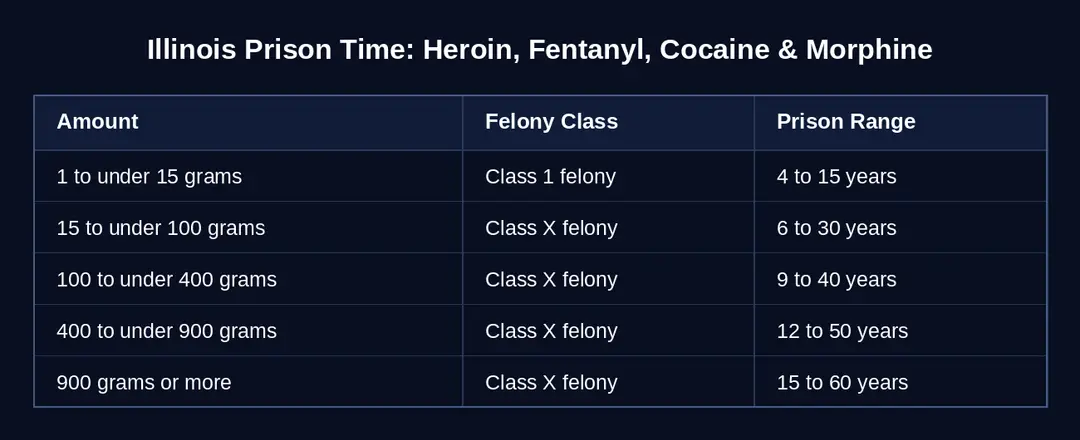
Two details worth knowing about this table:
Fentanyl carries an extra penalty on top of these ranges. If a mixture contains any amount of fentanyl, Illinois law adds 3 years to both the minimum and maximum sentence, regardless of which weight bracket applies.
Delivering to someone under 18 can also increase the exposure. Under 720 ILCS 570/407, a person 18 or older who delivers a controlled substance to a minor can be sentenced to up to twice the maximum term otherwise available and fined up to twice the standard amount.
Smaller amounts of Schedule I and II substances not covered above, along with drugs like LSD, amphetamine, and PCP, are generally charged as Class 2 or Class 3 felonies, carrying 3 to 7 years and 2 to 5 years respectively, with fines that vary by schedule.
Cannabis is not covered by the Controlled Substances Act. Manufacture, delivery, and possession with intent to deliver cannabis are punished under the Cannabis Control Act (720 ILCS 550/5), which uses its own weight-based scale:
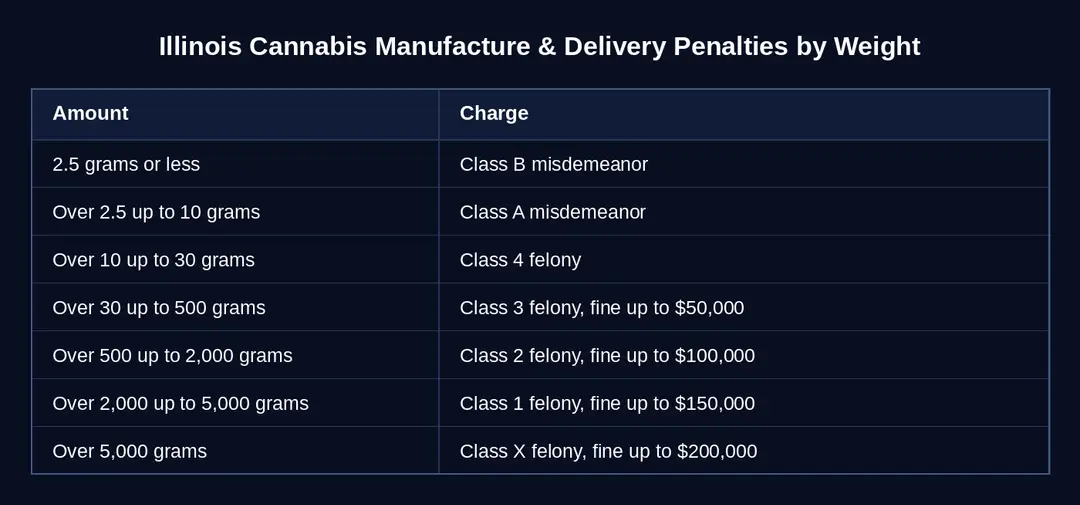
This is a point of real confusion since Illinois legalized recreational cannabis for adults 21 and older. As of June 2026, adults can legally possess up to 60 grams of cannabis flower, 10 grams of concentrate, and infused products containing up to 1,000 milligrams of THC, after the state doubled its adult-use possession limits. That legal personal-possession allowance is separate from the penalties above. The Cannabis Control Act penalties apply to manufacturing or delivering cannabis outside the state’s licensed dispensary system, regardless of how the amount compares to the personal possession limit.
A prison sentence is rarely the only consequence tied to a drug trafficking conviction. Depending on the charge, someone convicted may also face:
None of this happens automatically, and how a case is charged and negotiated has a real effect on which of these consequences actually apply.
A drug trafficking or possession with intent to deliver charge is not a conviction. Prosecutors carry the burden of proving several elements beyond a reasonable doubt, including that:
Any weak link in that chain, from how the substance was found to how it was weighed and tested, is a legitimate point to examine.
A charge is not a conviction, and the right defense depends on the specific facts, the evidence, and the court handling the case. Common areas defense attorneys examine in drug trafficking cases include:
An attorney can review the police reports, lab results, and circumstances of the arrest and explain what options are realistically available.

Drug trafficking charges in the Chicago area move through several different court systems depending on where the arrest occurred. Cook County cases are handled through the Cook County Circuit Court, with felony matters in the south suburbs often routed through the Markham courthouse. Will County and DuPage County run separate state’s attorney’s offices and separate court calendars, each with its own charging tendencies and plea negotiation patterns.
That local variation matters. A prosecutor’s office’s typical approach to a Class 1 possession with intent to deliver charge in one county is not necessarily the same in another, which is one reason knowing the specific court and prosecutor’s office involved is useful from the start.

Drug trafficking and possession with intent to deliver cases are built largely on how the state interprets circumstantial evidence: how drugs were packaged, how much cash was nearby, what a text message actually meant. Ktenas Law’s attorneys, including founding partner Alex Ktenas, a former Cook County prosecutor who worked cases in both Chicago and Markham, have seen how these cases get built from the other side of the table.
That experience shapes how the firm reviews a case: checking whether the lab work supports the alleged weight, whether the “intent to deliver” evidence holds up, and whether the charge itself matches the facts. No attorney can promise a specific result, but a careful review of the evidence is the starting point for any defense.
Drug trafficking and possession with intent to deliver charges move fast, and the weight and substance alleged in the first police report often shape the rest of the case. Ktenas Law reviews the evidence, the charge, and the court involved to explain what a person is actually facing and what comes next.
Free Case Review: (312) 800-1626
“Distribution” covers manufacture, delivery, and intent to deliver under 720 ILCS 570/401, while “trafficking” under 720 ILCS 570/401.1 applies specifically to bringing drugs into Illinois from out of state and carries a harsher sentence.
It depends on the charge, since Illinois restricts or eliminates probation for several higher-level drug offenses, including controlled substance trafficking under 720 ILCS 570/401.1.
Delivering more than 10 grams of cannabis is charged as at least a Class 4 felony under the Cannabis Control Act, separate from the legal personal possession limits for adults 21 and older.
Yes. Prosecutors must prove knowing possession, which gets harder to establish when multiple people had access to the same space.
Yes. Possession with intent to deliver falls under the same statute as manufacture and delivery and can carry the same felony-level exposure.