Blood Alcohol Concentration (BAC) in Illinois
 11/06/2026

Illinois treats the illegal sale or purchase of a firearm as a felony, not a citation. Depending on how the sale happened and who was involved, a conviction can carry anywhere from one year to several decades in prison.
These cases often start with a tip, a Firearm Owner’s Identification (FOID) card mismatch, or an undercover buy run by the Illinois State Police or the ATF. Many of them end up in both Cook County court and federal court at the same time.
At Ktenas Law, our attorneys built their careers as Cook County prosecutors before representing the accused. We know how these cases get opened, investigated, and charged, because we used to be on the other side of them. If you are under investigation or already charged, the fastest thing you can do for yourself is stop talking to investigators and talk to a lawyer first.

Illinois does not ban private firearm sales. It regulates how each one must happen. Under 720 ILCS 5/24-3 a sale becomes a crime the moment a required step is skipped, and the felony class depends on what was sold, to whom, and how many firearms were involved.
Illinois does not ban private firearm sales outright. It regulates how every sale has to happen, and a sale becomes a crime according to 720 ILCS 5/24-3(opens in a new tab) the moment it skips one of those steps.
A sale or transfer is illegal when the seller knowingly does any of the following:
A purchase becomes illegal in a different way. Illinois calls it a straw purchase: buying a firearm that you are legally allowed to own, then handing it to someone who is not. It does not matter whether money changed hands on the second transfer. The law looks at intent at the time of the purchase.
Illinois does not treat every illegal sale the same way. The felony class depends on what was sold, to whom, and how many firearms were involved.
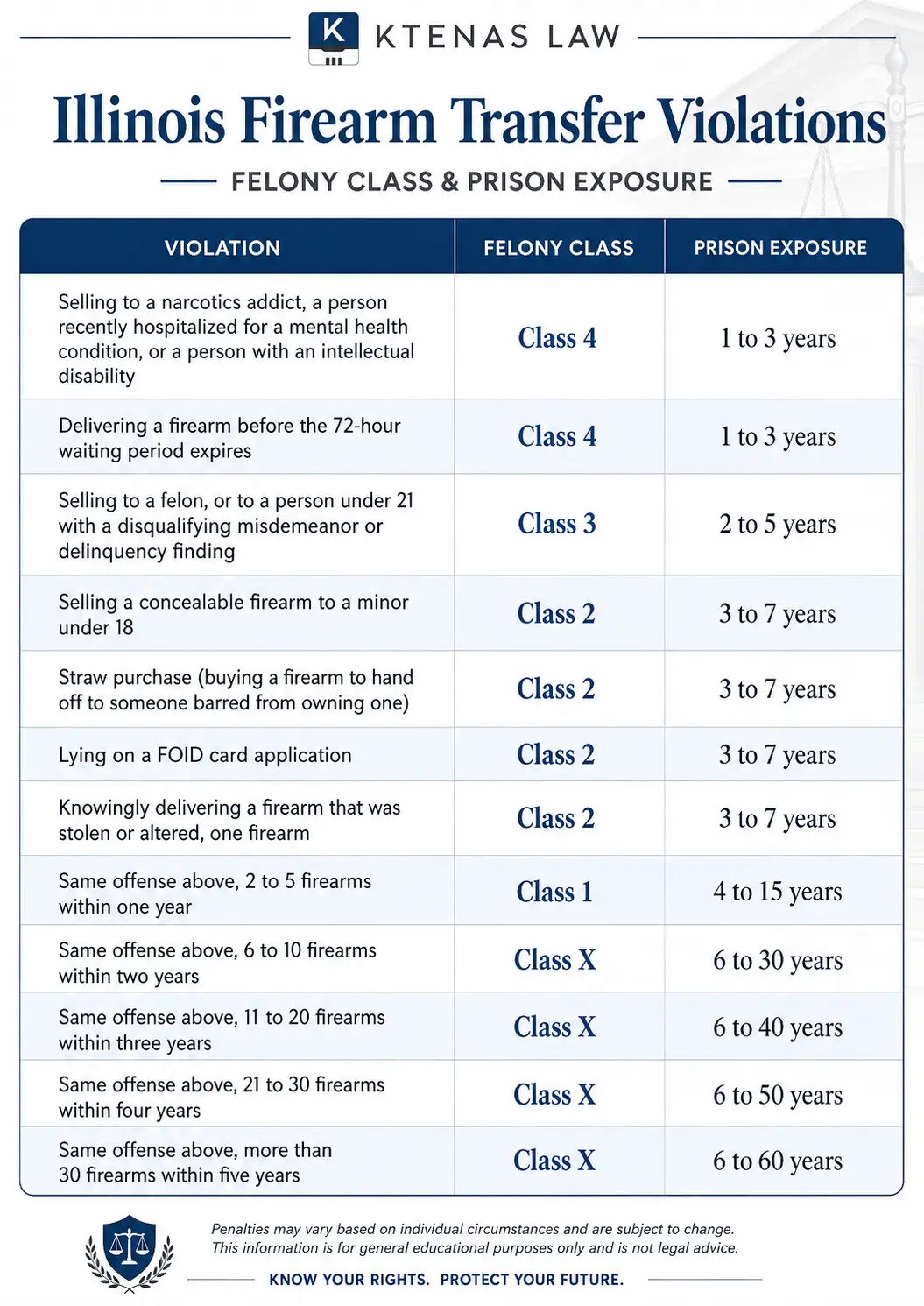
A second or subsequent violation committed in or near a school adds its own enhanced penalty, up to a Class 1 felony carrying 5 to 15 years.
Federal law runs alongside Illinois law, not instead of it. Dealing in firearms without a federal license under 18 U.S.C. § 922(a)(1)(A)(opens in a new tab) carries up to 5 years in federal prison and a fine of up to $250,000 under 18 U.S.C. § 924(a)(1)(D)(opens in a new tab). It is common for a case like this to draw charges from both the Cook County State’s Attorney and the U.S. Attorney’s Office for the Northern District of Illinois at the same time.
Separately, lying on a FOID card application is its own felony under the FOID Act(opens in a new tab) itself. The statute’s own required warning language states that entering false information on a FOID application is punishable as a Class 2 felony.
Federal law runs alongside Illinois law here rather than instead of it. Our gun charge defense page covers how the two stack.
A felony gun sale charge is not automatic just because a transfer looked irregular. Prosecutors carry the burden on every element, and that burden does not disappear because a defendant feels caught.
For an unlawful sale charge, the state generally has to show the seller knowingly sold or delivered the firearm, and knew or should have known about the disqualifying fact, whether that is the buyer’s felony record, the missing FOID card, or the unexpired waiting period.
For a straw purchase charge, intent is the entire case. The state has to show the buyer intended, at the time of purchase, to pass the firearm to someone who could not legally own it. A gift to a family member who happens to be otherwise eligible is not automatically a straw purchase. A purchase made because someone else asked and paid for it, for a person who could not pass a background check, usually is.
A charge is not a conviction, and the right defense depends on the specific facts, the evidence collected, and how the investigation unfolded.
Some of the defense angles that recur in Illinois gun sale and purchase cases include:
None of this guarantees an outcome. What it means is that the facts of a specific case, not the charge sheet alone, determine what is actually defensible.
The moments right after an arrest, a search, or a knock from an ATF agent shape the rest of the case more than almost anything that happens later.

Firearm sale and trafficking cases do not stay in one lane. A sale that starts as a Cook County matter, handled out of the Leighton Criminal Courthouse or a suburban courthouse, can get picked up by the ATF and refiled federally, particularly when multiple firearms, an interstate connection, or a straw purchase pattern is involved. Task forces built around reducing gun trafficking specifically look for exactly that pattern.
That overlap matters for defense strategy. A plea or an admission made assuming only a state case exists can create serious problems if the same conduct later draws a federal charge. Anyone facing a gun sale or purchase charge in Cook County should assume, until told otherwise by counsel, that federal exposure is possible.
Alex Ktenas, Nick Ktenas, and Lauren Ktenas each spent years as Illinois prosecutors before founding this firm in Cook County and Will County. That background means we know how a case like this moves through the system: what a state’s attorney looks for before filing, how ATF referrals get built, and where the gaps in an investigation usually show up.
We are not able to promise a particular result, and any attorney who does should raise a red flag. What we can do is take the specific facts of your situation, the paperwork, the timeline, the way the investigation happened, and build a defense around what actually happened, not around a generic script.
If you are facing an illegal firearm sale or purchase charge in Illinois, or you believe you are under investigation, contact Ktenas Law for a free case review. Call (312) 800-1626 to speak with our team.
Yes. Illinois requires every firearm transfer, including private sales between individuals, to go through FOID verification and the applicable waiting period. Skipping that step can turn an otherwise legal private sale into a felony.
A straw purchase is buying a firearm for someone who cannot legally own one. Illinois treats the intent behind the purchase, not just the transaction itself, as the crime, and charges it as a felony.
Yes. Illinois and federal law both regulate firearm sales, and a single transaction, especially one involving multiple firearms or a suspected trafficking pattern, can draw charges from the Cook County State’s Attorney and the U.S. Attorney’s Office at the same time.
Illinois law makes this a Class 2 felony under the FOID Act itself, separate from any charge tied to the firearm sale or purchase. The application form is required to carry this warning in bold print.