
Felony DUI in Will County: How Aggravated DUI Cases Move Through Joliet
 11/17/2026
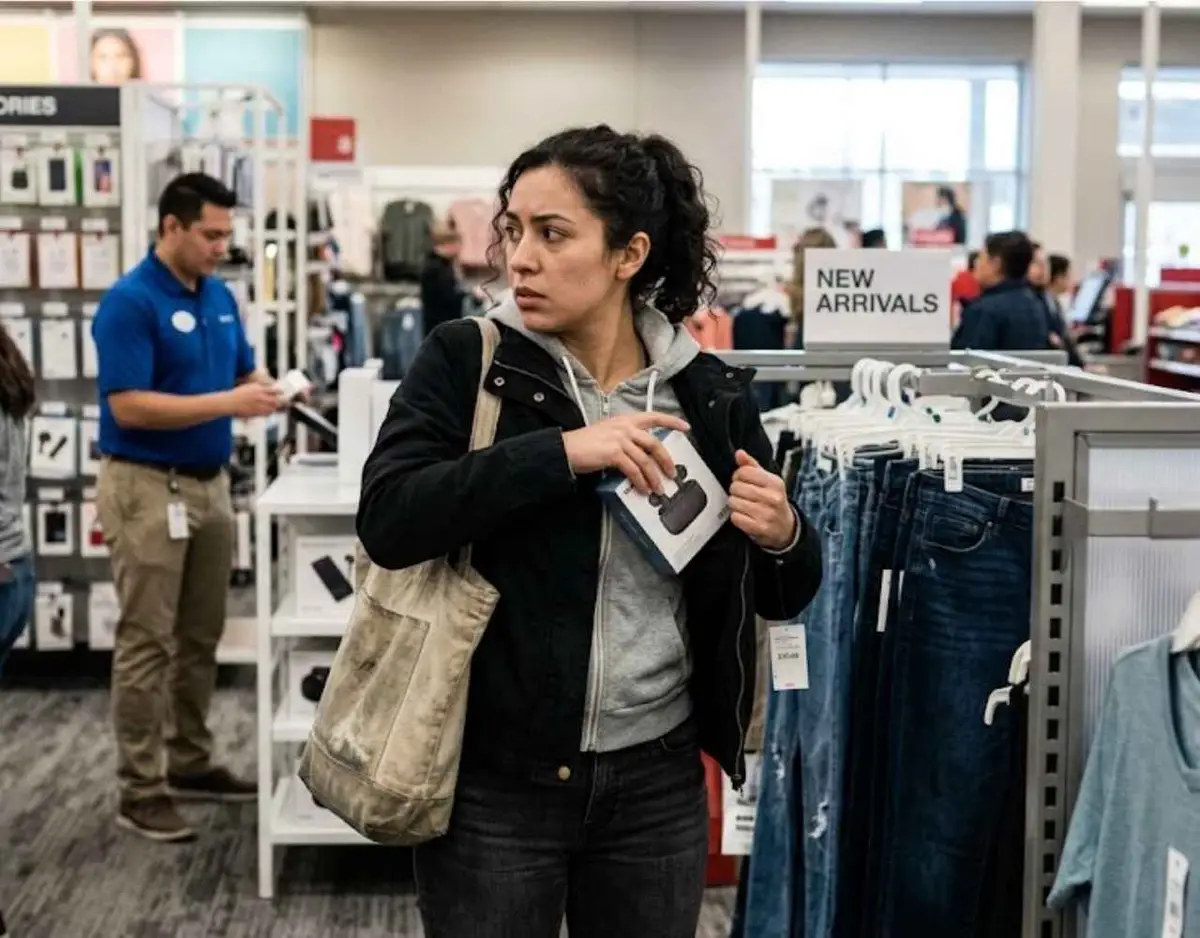
A shoplifting stop or a theft accusation can turn into a felony record faster than most people expect. Illinois treats theft from a store and theft in general as two different crimes with two different dollar lines, and Cook County recently changed how aggressively it charges the store version. If you or someone you love was arrested for theft or retail theft anywhere in Illinois, including Chicago, Orland Park, Tinley Park, Homewood, or Frankfort, Ktenas Law can walk you through what the charge actually means before you say another word to police or a loss prevention officer.
For retail theft, the felony line sits at $300, or $150 for motor fuel. Take $300 or less and, absent other factors, the charge is a misdemeanor. Ordinary theft runs under a different statute with a different threshold, which is why the exact charge matters.

Illinois splits theft charges by dollar value, and the split works differently depending on where the theft happened.
If you are accused of taking merchandise from a store, the law that applies is retail theft under 720 ILCS 5/16-25. The felony line for retail theft sits at $300 (or $150 for motor fuel). Take $300 or less and, absent other factors, you are looking at a Class A misdemeanor. Cross $300 and the same conduct becomes a Class 3 felony.
If the theft was not from a retail store, the general theft statute applies instead, 720 ILCS 5/16-1. That law uses a higher misdemeanor ceiling of $500 for property not taken directly from another person.
The two statutes are not interchangeable, and mixing them up is one of the fastest ways to misjudge what a case is actually worth. A few other things move the number even when the dollar amount does not:
Every one of these variables can move a case from a fine and a court date to a felony record, so getting an accurate read on the charge early matters.
People use “shoplifting,” “retail theft,” and “theft” as if they mean the same thing. Under Illinois law, they split into two separate statutes with separate rules.
Retail theft (720 ILCS 5/16-25) covers taking, hiding, or altering price tags on store merchandise, switching packaging to pay less, defeating a security tag, walking out with a shopping cart, or under-ringing an item at checkout. “Shoplifting” and “retail theft” describe the exact same offense in Illinois. There is no separate, lesser shoplifting charge.
Theft (720 ILCS 5/16-1) is the broader offense. It covers taking someone’s property outside a retail setting, obtaining property through deception or threat, or knowingly holding onto property you know is stolen.
The practical difference that trips people up most:
A worker accused of stealing $400 in cash from a coworker is looking at a misdemeanor. A shopper accused of taking $400 in merchandise from that same coworker’s store is already over the retail theft felony line.
Retail theft and ordinary theft are separate statutes with separate rules. Our criminal defense team checks which one you are actually charged under.
Penalties come from Illinois’ sentencing statutes, not from the theft law itself. Two separate numbers matter for any conviction: the prison or jail exposure, and the maximum fine.
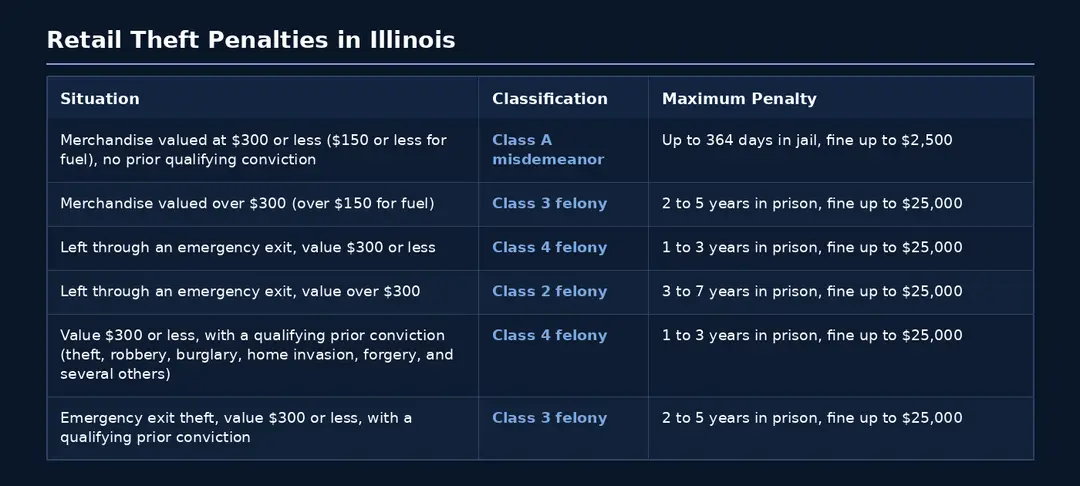
A common misconception: leaving through an emergency exit is automatically a Class 4 felony no matter the value. It is not. The enhancement bumps the charge up one class from whatever it would otherwise be. Under $300, that lands at Class 4. Over $300, it escalates all the way to Class 2.
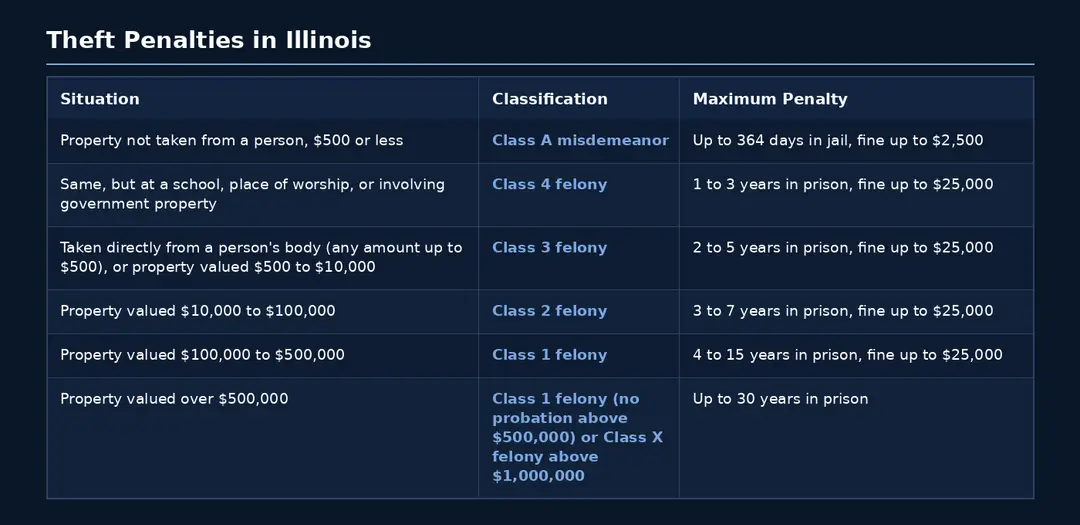
A note on stolen vehicles: Illinois does not have a separate “grand theft auto” charge. Taking a car can be charged as ordinary theft under the table above. Knowingly possessing, driving, or transferring a vehicle you know is stolen is a different offense, 625 ILCS 5/4-103, and that charge is always a Class 2 felony no matter the vehicle’s value.
These are maximum exposures set by statute, not predictions of what will happen in any specific case. Actual sentencing depends on the judge, the county, the defendant’s history, and the facts, and probation is available for many of these classifications.
A theft charge is not automatically a conviction. Prosecutors carry the burden on every element, and for both retail theft and ordinary theft, that generally means proving:
That last point matters more than most people realize. Under both statutes, when a charge depends on crossing a dollar threshold, the value of the property is an element of the offense that a judge or jury has to resolve, not something the state can simply assert. Retail price tags, receipts, and loss prevention estimates are not automatically accepted as fact.
Illinois law also allows a “permissive inference” of intent in certain retail theft situations, for example when someone conceals merchandise and walks past the last point of sale without paying. An inference is not a presumption of guilt. It allows a judge or jury to consider intent, but the state still has to prove the case.
Every theft case turns on its own facts, and no outcome can be promised in advance. That said, the same handful of issues come up again and again in retail theft and theft cases:
A defense attorney’s job is to test each of these against the specific facts of the case, not to promise a particular result before that review happens.

What happens in the hours and days right after an arrest can shape the rest of the case.
Local charging policy can matter as much as the statute itself, and Cook County is a clear example.
What changed. For several years, the Cook County State’s Attorney’s Office would not pursue felony retail theft charges unless the merchandise exceeded $1,000, well above the $300 line set by state law. That changed on the current State’s Attorney’s first day in office. The office now charges felony retail theft in line with the statute: at $300, or whenever the accused already has a prior shoplifting conviction.
What it means for you. A $350 shoplifting case in Cook County that might once have stayed a misdemeanor is now more likely to be charged as the Class 3 felony the statute allows. Charging practices differ by county and can shift again with a new administration, so it is worth confirming the current policy rather than assuming.
Where these cases are heard. Cook County theft and retail theft(opens in a new tab) cases move through the Circuit Court of Cook County’s municipal districts, including the Sixth Municipal District in Markham for the south suburbs. Which courthouse, which prosecutor’s unit, and which judges are involved shapes how a case is prepared from day one.
Founding partner Alex Ktenas spent years as an Assistant State’s Attorney in Cook County, prosecuting cases in both Chicago and the Markham courthouse before founding Ktenas Law. That background means he has sat on the other side of a retail theft or theft file, seen how loss prevention reports and surveillance footage actually get built into a case, and worked directly with the judges and prosecutors who now handle these charges in Cook County courts.
Partner Nick Ktenas brings the same scrutiny to the evidence itself, going through surveillance footage, receipts, and loss prevention documentation line by line rather than accepting a store’s account of what happened at face value.
If you are facing a theft or retail theft charge anywhere Ktenas Law serves, from Chicago and Orland Park to Tinley Park, Homewood, and Frankfort, that combination of prosecutorial background and close evidence review is what goes into building your defense.

A theft or retail theft charge can move fast, from a store detention to a court date to a felony record, if it is not handled carefully from the start. Ktenas Law reviews the specific facts of your case, including the surveillance footage, the valuation, and any prior record, before deciding how to approach it. Call (312) 800-1626 for a Free Case Review, or submit a request through our contact page.
Retail theft covers store merchandise and becomes a felony over $300. Ordinary theft covers property taken elsewhere and does not become a felony until $500.
No. Illinois has one offense for it: retail theft under 720 ILCS 5/16-25.
Not automatically. Under $300 with no aggravating factors is generally a Class A misdemeanor.
It depends on the offense, the classification, and Illinois’ expungement and sealing rules. An attorney can review your specific case and explain what may be available.
It can be, but a stolen vehicle case is often charged instead as possession of a stolen motor vehicle under 625 ILCS 5/4-103, which is always a Class 2 felony regardless of value.