Ignition Interlock Device Program Illinois BAIID
 11/21/2026

Finding out that a court has issued a warrant for your arrest is unsettling, but it does not mean your case is already decided. Illinois courts issue thousands of warrants every year, and most of them get resolved without the dramatic scene people picture. At Ktenas Law, our attorneys are former Illinois prosecutors, so we know how the state builds these cases and how a warrant moves through the system from the inside.
This article walks through the type of warrant you may be facing, why it was likely issued, and the steps you can take right now, whether you already know about the warrant or you just want to check.
A warrant does not expire, and it does not go away on its own. It stays active until it is quashed or you are taken into custody, which means a routine traffic stop years later can end in an arrest. Handling it deliberately, with counsel, is almost always better than waiting.
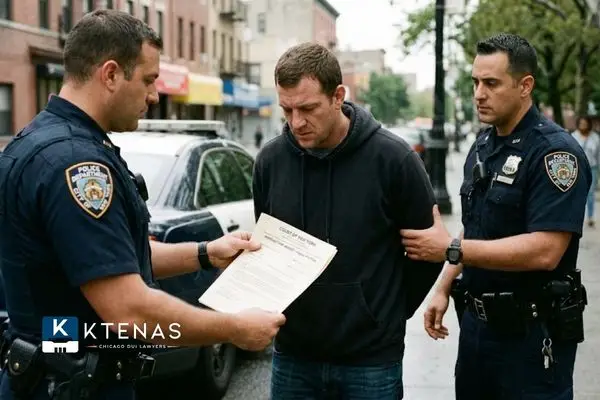
If you think a warrant has been issued for your arrest, do not ignore it and do not turn yourself in without talking to an attorney first. Contact a criminal defense lawyer before you go to a police station or courthouse. An attorney can confirm whether a warrant actually exists, find out what it is for, and in many cases arrange for you to appear in court on your own terms instead of being arrested at home, at work, or during a traffic stop.
Avoid discussing the situation with police officers beyond identifying yourself. Anything you say can end up in the case against you, even a casual comment meant to explain your side. Write down what you remember about the underlying incident while it is fresh, then bring those notes to your attorney instead of the police.
Illinois recognizes three main categories of warrant. Each one authorizes a different action, and confusing them leads to bad decisions about what to do next.
Walking into court with an attorney is a very different appearance than being brought in on the warrant. Our criminal defense team arranges the first one.
An arrest warrant is a written order signed by a judge, based on a sworn complaint, directing officers to take a specific person into custody. Under 725 ILCS 5/107-9, a judge can only issue one after finding probable cause that a crime happened and that the named person committed it.
A bench warrant comes directly from the judge presiding over an existing case, most often because someone missed a scheduled court date. Illinois no longer uses cash bail. Since the Pretrial Fairness Act took effect on September 18, 2023, judges set non-monetary conditions of release instead of a dollar amount, so getting a bench warrant lifted is not simply a matter of paying a bond. An attorney can often file paperwork asking the court to recall the warrant and set a new date, which lets you handle the missed appearance without being taken into custody first.
A search warrant is different from the two above. It authorizes officers to search a specific place, described in the warrant itself, for specific items connected to a crime. It does not by itself authorize an arrest, though officers may arrest someone during a search if they find evidence or observe a crime. Illinois law spells out the requirements for issuing and executing one in 725 ILCS 5, Article 108(opens in a new tab).
A warrant rarely appears out of nowhere. Some of the situations that commonly lead to one include:
None of these situations mean a conviction is coming. A warrant only reflects that a judge found enough basis to authorize your appearance in court or your arrest, not that the underlying charge has been proven.
There is no single national database the public can search to confirm a warrant, but Illinois gives you a few reliable starting points. The Cook County Clerk of the Circuit Court’s online case search lets you look up an existing case by name, though the clerk’s office notes that online records are not the official file and can lag behind real-time activity. Other Illinois counties offer similar case lookup tools through their own circuit clerk websites.
If you already have an open case, a missed notice, or a former court date you are unsure about, the fastest and most accurate way to find out is to have an attorney contact the court on your behalf. This avoids the risk of showing up at a courthouse public terminal and walking into an active warrant unrepresented.
Illinois treats misdemeanor and felony warrants differently, and the distinction affects how the situation should be handled.
A misdemeanor warrant typically involves a lower-level charge, and an attorney has more room to negotiate a voluntary court date instead of an arrest. A felony warrant carries more weight. It can mean police treat the matter as a higher priority, and bond or release conditions are more likely to be contested. In either case, a defense attorney’s first job is usually the same: find out exactly what the warrant says, confirm the charge and the court, and map out the safest way to address it.

Many people confuse an arraignment with a trial, but they are not the same thing. An arraignment, sometimes called a first appearance, is the hearing where the court formally tells you what you are charged with and you enter a plea, typically not guilty at this early stage.
At that hearing, the judge also addresses pretrial release. Since Illinois abolished cash bail, the court decides whether to release you on your own recognizance or impose non-monetary conditions, such as check-ins or travel limits, based on flight risk and safety rather than your ability to pay. Only certain serious felony charges allow the state to ask that you be detained pending trial, and the judge must find clear and convincing evidence to justify it. Nothing gets decided about guilt at this stage. That happens later, if the case proceeds to trial or a plea agreement.
If you are arrested, several rights apply immediately, whether or not officers remind you of them.
These protections come from the Fifth and Sixth Amendments and are commonly called your Miranda rights. If police question you in custody without informing you of them, a court may later exclude anything you said during that interrogation.
If you believe you are being held longer than is reasonable without being brought before a judge, an attorney can ask a court to issue a writ of habeas corpus(opens in a new tab), an order requiring whoever is holding you to bring you before the court so a judge can review whether the detention is lawful.
Once you know a warrant exists, a few practical steps put you in a stronger position.

Ktenas Law was built by former Illinois prosecutors, Alex Ktenas, Nick Ktenas, and Lauren Ktenas, who spent years on the other side of cases like this one. That background matters most in exactly this situation: knowing which judges and courtrooms are involved, how a warrant was likely requested, and what a controlled, voluntary appearance actually looks like in practice.
If you think there may be a warrant out for your arrest, do not wait for officers to find you first. Call Ktenas Law at (312) 800-1626 for a Free Case Review, or reach us through our contact page, before you make a decision you cannot undo.
No. Illinois eliminated cash bail under the Pretrial Fairness Act, effective September 18, 2023. A judge now sets non-monetary release conditions based on flight risk and public safety instead of a dollar amount.
Generally, no. A warrant typically stays active until it is served, recalled by the court, or the underlying case is otherwise resolved. It does not disappear simply because time has passed.
Often, yes. A defense attorney can contact the court, confirm the warrant, and in many cases ask the judge to recall it and schedule a voluntary court date instead of a street arrest.
A summons or notice to appear asks you to show up in court on a set date without being taken into custody. A warrant authorizes officers to arrest you. Missing a summons date is one of the most common reasons a warrant follows.
Officers are generally expected to inform you of the warrant and the charge, though the warrant itself does not always have to be physically shown at the moment of arrest. Confirming the exact basis for the warrant is something your attorney can do quickly through the court.