How Long Does a DUI Stay on Your Record in Illinois?
 11/10/2026
Illinois legalized recreational cannabis in 2020, and lawmakers just doubled how much adults can legally carry. That combination confuses a lot of people, and confusion is exactly how a routine stop turns into a criminal charge. If you were arrested with cannabis in Chicago or anywhere in Cook County, the outcome depends on details most people never think to check: how much you had, where you got it, your age, and whether you were over the legal limit.
Ktenas Law defends cannabis possession charges across Chicago and Cook County. Below is a plain-English breakdown of what Illinois law actually allows in 2026, what turns legal possession into a criminal charge, and what the penalties look like at each level.
It depends on the amount, your age, and where the cannabis came from. An Illinois resident 21 or older who bought from a licensed dispensary can legally possess it. Go over the limit, or sell without a license, and it is a charge again.
It depends entirely on the amount, your age, and where the cannabis came from.
If you are 21 or older, an Illinois resident, and you bought your cannabis from a licensed dispensary, you can legally possess it in Chicago. As of June 12, 2026, Illinois residents may legally carry up to 60 grams of cannabis flower, 10 grams of cannabis concentrate, and cannabis-infused products containing up to 1,000 milligrams of THC, combined across categories. Out-of-state visitors 21 and older are held to half those amounts.
Outside those boundaries, cannabis possession is still a crime in Illinois. That includes:
When one of those applies, Illinois charges cannabis possession under a separate law, and the penalty scales sharply with weight. That’s the part of this article most people actually need.
Two different laws govern cannabis in Illinois, and they work together.
The Cannabis Regulation and Tax Act sets the possession limit for legal adult use. As of the June 2026 update, Illinois residents 21 and older can possess up to 60 grams of flower, 10 grams of concentrate, and 1,000 milligrams of THC in infused products. Non-resident visitors are capped at half those amounts. Anyone under 21 has no legal possession allowance at all, regardless of amount.
The Cannabis Control Act picks up everywhere the Cannabis Regulation and Tax Act doesn’t authorize possession. If you’re over the legal limit, sourced your cannabis illegally, or you’re under 21, this is the law that applies, and it charges by weight in a rising scale, from a ticket at the low end to a felony at the high end.
A few things that matter regardless of amount:
Two laws work together here: the Cannabis Regulation and Tax Act sets the legal limit, and the Controlled Substances Act governs everything past it. Our drug charge defense page explains the line.
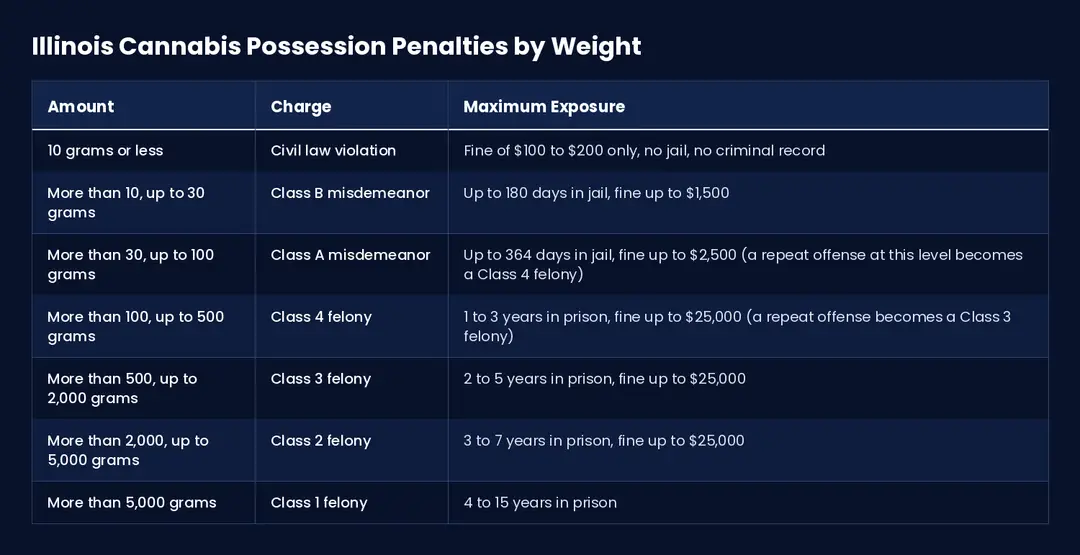
When cannabis possession falls outside what the Cannabis Regulation and Tax Act authorizes, Illinois charges it under 720 ILCS 550/4(opens in a new tab), and the classification climbs with the amount involved:
A related charge worth knowing about: possessing a pipe, grinder, or other item with the intent to use it for cannabis is a separate offense under the Drug Paraphernalia Control Act. It’s a Class A misdemeanor carrying a mandatory minimum fine of $750, on top of whatever the cannabis charge itself carries.
If police believe the cannabis was meant for sale rather than personal use, that’s an entirely different and more serious charge (unlawful delivery, or possession with intent to deliver), with its own penalty structure and often a school-zone enhancement if the alleged conduct happened near a school. That charge deserves its own conversation with an attorney and isn’t something a general overview like this one should try to estimate for you.
A cannabis charge is not the same thing as a conviction. Before the State can convict you of unlawful possession, prosecutors generally have to prove, beyond a reasonable doubt, that:
Each of those elements can be challenged. Knowledge and control are frequently the weakest links in a cannabis case, especially when cannabis is found in a shared vehicle, a shared residence, or somewhere multiple people had access.
The right defense depends on the facts of the stop, the search, and the lab results, but a few issues come up often in these cases:
None of this guarantees a particular outcome. Penalties can vary based on prior history, the facts of the case, and the judge or court handling it. An attorney can review the police report, the lab results, and the circumstances of the stop to tell you which of these actually apply to your situation.

What you do in the first day or two after an arrest can affect how the case unfolds later.
Cannabis possession charges out of Chicago typically move through Cook County’s court system, which handles an enormous volume of drug cases every year. Lower-level cannabis charges are often resolved without a lengthy trial process, but “often” isn’t “always,” and how a specific courtroom or prosecutor’s office handles a given weight tier can shift over time.
This is where local experience matters. Ktenas Law is built on former Cook County prosecutors, including attorneys who worked directly in the Cook County State’s Attorney’s Office. That means knowing how a given courtroom tends to handle a case at a given charge level, not just what the statute says on paper.
It’s tempting to treat a low-level cannabis ticket as something to just pay and move past. Sometimes that’s the right call. But the civil violation tier only applies if the facts actually support it, and police reports get the details wrong more often than people expect: a scale error, an assumption about who the cannabis belonged to, or a packaging weight that pushed the number into misdemeanor territory. A charge that looks minor on paper can carry real consequences if it’s actually the wrong charge, or if it’s one part of a larger case involving other allegations.
Ktenas Law reviews the specifics of your stop, your charge, and the evidence before advising you on next steps. Contact our office for a Free Case Review, and don’t wait until your court date to get a straight answer about where you actually stand.
Yes, within limits. Adults 21 and older who are Illinois residents can legally possess cannabis purchased from a licensed dispensary, up to the state’s possession limits. Anyone under 21, or anyone over the limit, is outside legal protection and can be charged.
As of June 2026, Illinois residents 21 and older can carry up to 60 grams of cannabis flower, 10 grams of concentrate, and cannabis-infused products with up to 1,000 milligrams of THC, combined. Out-of-state visitors are limited to half those amounts.
The charge scales with weight, from a civil fine at the lowest tier up to a felony at higher amounts. Ten grams or less is a civil ticket. Amounts above that move through misdemeanor and then felony classifications as the weight increases.
Illinois law requires cannabis in a vehicle to be in a reasonably secured, sealed container that isn’t easily reachable while the car is moving. Loose cannabis within reach of the driver can create legal exposure even if the total amount is within your legal limit.
Illinois has expanded automatic expungement eligibility alongside the 2026 possession limit increase, now covering qualifying convictions for possession of up to 60 grams. Eligibility depends on the specific conviction and case history, so it’s worth a direct conversation with an attorney rather than assuming either way.
No. A civil law violation under the 10-gram tier is not a criminal conviction. It’s a fine only, similar to a traffic ticket. Anything above that tier is a criminal charge and can result in a record if it leads to a conviction.