



Is a Gun Charge a Felony in Illinois?
 09/18/2026
A new Illinois DUI arrest is stressful enough. It gets more complicated fast when a prior DUI in another state enters the picture. Many drivers assume an old out-of-state case stays out of their Illinois record entirely, or that it only matters if it happened in Illinois. Neither is true.
Illinois law counts an out-of-state DUI conviction as a prior offense, and that single fact can change the criminal charge, the length of a license suspension, and what it takes to get back on the road. Chicago DUI Lawyers is built around a team of former Illinois prosecutors who understand exactly how the state uses out-of-state records against a defendant, in courtrooms across Illinois. Call (312) 800-1626 for a free case review before your next court date.

Yes. Under 625 ILCS 5/11-501(e), any reference to a prior DUI violation in Illinois includes a similar conviction under the law of another state. It does not matter whether the other state calls it “DUI,” “OWI,” “OUI,” or something else. If the offense involved impaired or drunk driving in a way similar to Illinois’s law, Illinois courts treat it as a prior violation.
This matters because the difference between a first DUI charge in Illinois and a second one is not just a formality. It changes sentencing exposure, license consequences, and how much room a defense attorney has to negotiate.
Illinois is a member of the Driver’s License Compact, an agreement among most states under 625 ILCS 5/6-702 that requires the state where a conviction occurs to report it to the driver’s home state. Under 625 ILCS 5/6-703, Illinois then gives that out-of-state DUI conviction the same effect it would give an Illinois conviction for license purposes.
In practice, this means a certified driving abstract from the Illinois Secretary of State will often show an out-of-state DUI even if the person never disclosed it. Prosecutors can also use a certified copy of that driving abstract as proof of a prior conviction under 625 ILCS 5/11-501(h). Assuming an old case will not surface is a common and costly mistake.
A first Illinois DUI is typically a Class A misdemeanor. Under 625 ILCS 5/11-501(d)(opens in a new tab), a third violation, including a similar out-of-state offense, becomes Aggravated DUI, a Class 2 felony. There is no stated lookback period in this section of the statute, so an out-of-state conviction from years ago can still count.
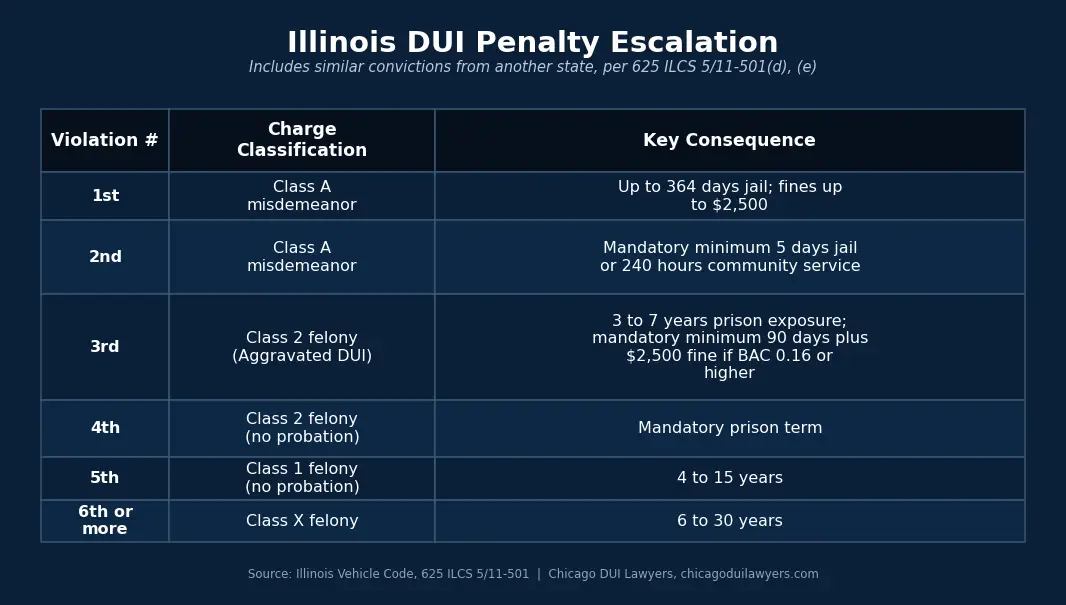
A multiple DUI charge built partly on an out-of-state record also carries mandatory minimums that a judge cannot suspend, including jail time or community service, under 625 ILCS 5/11-501(f).
Separately from the criminal case, an out-of-state DUI affects the Statutory Summary Suspension tied to the current Illinois arrest. Under 625 ILCS 5/11-500, a person is not a “first offender” if they have a prior out-of-state conviction for driving under the influence or a similar offense. Losing that status roughly doubles or triples the administrative suspension under 625 ILCS 5/6-208.1:
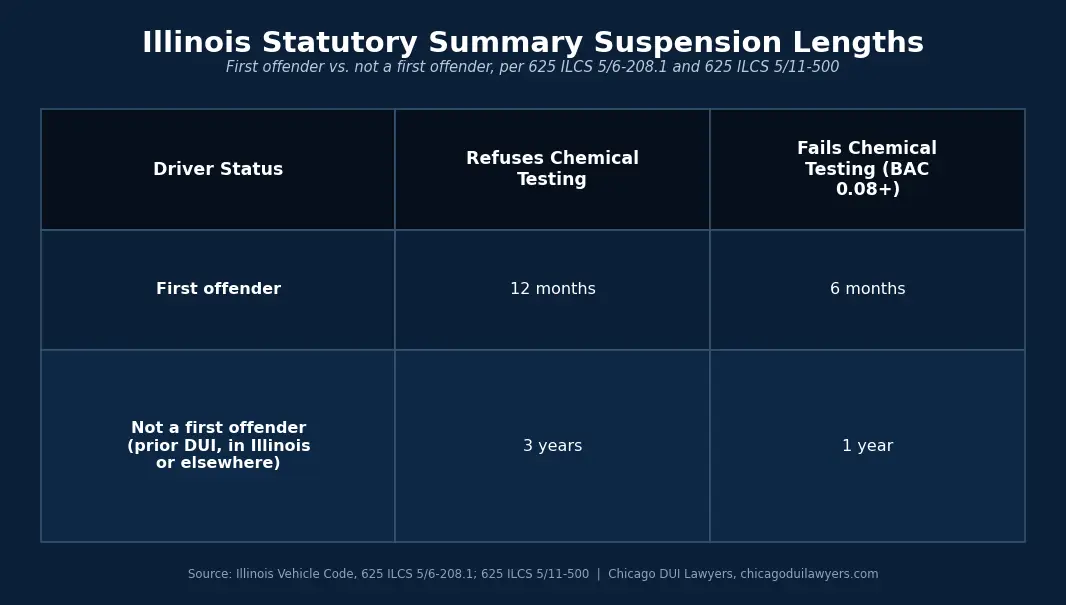
A formal hearing to challenge the suspension can still be requested, and the grounds are set out in 625 ILCS 5/2-118.1. The suspension itself takes effect on the 46th day after notice is served, which is the window our team uses to prepare and file that petition.
Beyond the current case, prior out-of-state offenses also stretch out license revocation once there is a conviction. Under 625 ILCS 5/6-208, a second violation within a 20-year period, counting out-of-state offenses, leads to a 5-year revocation, and a third leads to 10 years. A fourth or later violation can mean the Secretary of State will not accept a new application at all, with only narrow relief available.
Drivers facing these longer revocations typically cannot get back on the road with a standard license. Instead, the path runs through a Restricted Driving Permit under 625 ILCS 5/6-206.1, which generally requires installing a Breath Alcohol Ignition Interlock Device and maintaining a clean record with that device for a set period before full driving privileges return.

An out-of-state prior raises the stakes, but it does not decide the case. The state still has to prove impaired or drunk driving beyond a reasonable doubt, and it still has to prove the out-of-state conviction actually qualifies as a similar offense under Illinois law. That second point gets overlooked constantly, and it is often where a charge gets knocked back down, whether the case is in Chicago, the suburbs, or elsewhere in Illinois.
Our team brings prosecutorial experience from across Illinois. Alex Ktenas spent years as a prosecutor in Cook County, including Chicago and Markham, and Lauren Ktenas built her courtroom experience in Will County. That combined insider knowledge of how Illinois prosecutors build enhanced DUI cases matters most when a prior conviction, in Illinois or another state, is on the table. Every case still turns on the facts: the traffic stop, the field sobriety testing, and whether the breath or blood test was administered correctly. Reserve a Priority Case Review by calling (312) 800-1626 so we can start looking at those facts before your next hearing.
Yes. Illinois law treats a similar out-of-state conviction the same as an Illinois DUI conviction for purposes of charging enhancement and license consequences.
Primarily through the Interstate Driver’s License Compact, which requires member states to report convictions to a driver’s home state, and through the driver’s own certified driving abstract.
It can. A third DUI-type violation, including a qualifying out-of-state offense, is charged as Aggravated DUI, a Class 2 felony, under Illinois law.
Yes. It removes “first offender” status, which increases the suspension length tied to the current arrest.
In many cases, yes, but it generally requires a Breath Alcohol Ignition Interlock Device and a clean compliance record for a set period. Eligibility depends on the specific history involved.
It depends on how the other state’s disposition is classified and whether Illinois treats it as a conviction. This is exactly the kind of detail an attorney should review with your driving abstract in hand.

09/18/2026

09/18/2026

09/17/2026