



How Will a Criminal Record Affect Finding a Job in Illinois?
 10/11/2026
Getting arrested for driving under the influence in Illinois does not automatically mean a conviction follows you for life. Illinois offers one sentencing option, called court supervision, that can end a DUI case without a criminal conviction ever entering your record. It is not automatic; it is not available to everyone, and you only get to use it once.
At Ktenas Law, our attorneys spent years as prosecutors before we started defending DUI cases across Illinois. We know what a judge and a state’s attorney weigh before agreeing to supervision, because we used to be the ones arguing against it. If you were arrested for a first DUI and want to know whether supervision is realistic in your case, call us at (312) 800-1626 for a free case review.
Court supervision is a sentencing disposition under 730 ILCS 5/5-6-1. A judge defers entering a final judgment and instead places you under a set of court-ordered conditions for a fixed period. If you complete every condition, the judge discharges you and dismisses the DUI charge. No conviction is ever entered.
That single fact changes everything else that follows a DUI. A conviction under Section 11-501 of the Illinois Vehicle Code(opens in a new tab) triggers a mandatory license revocation through the Illinois Secretary of State. Supervision, because it is not a conviction, does not trigger that revocation.
Supervision is not the only alternative to a straight conviction, but it is the strongest one:
Supervision is one of several possible outcomes in a DUI case, and often the one worth fighting hardest for. It is not the same as a dismissal at arrest, and it is not an acquittal. It works more like a conditional bargain: meet every requirement for the length of the order, and the case closes without a criminal record.
Miss a condition, and a judge can resentence you as though supervision never happened. It is also never automatic. A judge decides whether to grant it, and only after you clear a separate eligibility test.
Illinois allows supervision for a DUI exactly once in a lifetime. You are not eligible if you have ever:
There is no time limit on this bar. It does not reset after five years, ten years, or twenty.
Once you use supervision for a DUI, or once a prior DUI conviction sits on your record, the option is gone permanently. If this is not your first arrest, an entirely different set of penalties applies to a second DUI.
Supervision is also never available for a felony DUI. Illinois elevates a DUI to a felony in situations such as a passenger under 16 in the vehicle, a crash causing great bodily harm, or driving without a valid license, and Section 5-6-1(c) excludes felony charges from consideration outright.
A common point of confusion: the Secretary of State uses a different “first offender” definition for a different purpose, and the two get mixed up often.

Mixing the two up leads people to assume they are eligible for supervision when they are not, or the reverse.
Eligibility only gets you in the door. Illinois law gives the judge discretion, not an obligation, to grant supervision even to a qualifying first-time offender.
The court has to be convinced of three things before entering an order for supervision:
The court also considers the state’s attorney’s position on the case. Several practical factors shape how a judge exercises that discretion:
Being eligible does not mean a judge will grant supervision, and no attorney can promise a specific result before a judge has actually reviewed the case.
A period of supervision lasts however long the court sets, up to a maximum of two years.
Illinois law requires a professional alcohol or drug evaluation before a judge can even enter the order. The local probation department typically conducts this evaluation. The results determine your risk classification, which can mean anything from a short alcohol education class to more intensive substance abuse treatment.
Beyond the evaluation, a judge has wide discretion to add conditions. These commonly include:
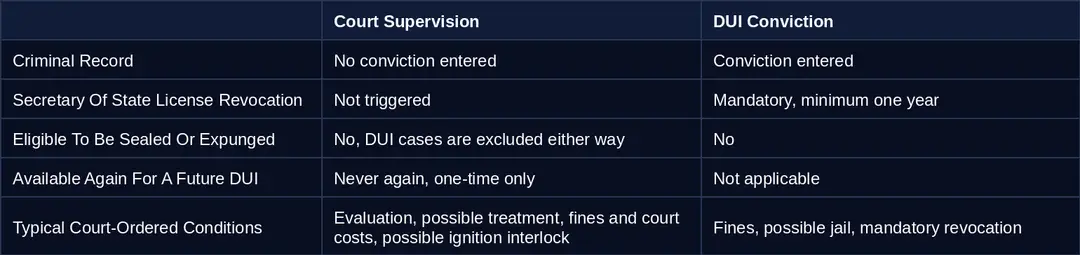
Here is how supervision compares to a conviction on the same DUI charge:
Supervision keeps the Secretary of State from revoking your driving privileges the way a conviction would. It does not touch a separate process called statutory summary suspension, which begins automatically based on your chemical test result or refusal, regardless of how the criminal case turns out.
That suspension runs on its own timeline, independent of whether a judge later grants supervision.
If you qualify as a first offender under the Secretary of State’s five-year definition, you may be able to apply for a Monitoring Device Driving Permit. This lets you keep driving during the suspension with a breath alcohol ignition interlock device installed. Our Illinois DUI process page walks through how the criminal case and the license suspension move on separate tracks at the same time.
A violation can come from missing court dates, failing a drug or alcohol test, skipping the Victim Impact Panel, or picking up a new charge. If you miss a condition, the state can file a Petition to Revoke.
You are entitled to a hearing on that petition. The state has to prove the violation by a preponderance of the evidence, with your right to counsel and to cross-examine witnesses fully intact. A judge cannot revoke supervision just because you fell behind on a fee or fine, unless the court finds you willfully refused to pay.
If the court does find a genuine violation, though, it can resentence you to any penalty that was available at the original hearing. That includes a conviction, license revocation, and jail time for a misdemeanor DUI.
If you have been served with a Petition to Revoke, treat it with the same urgency as the original arrest. The protection supervision gave you stays on the table only until a judge decides to take it away.
Successful supervision keeps a conviction off your record, but it does not erase the arrest. Illinois law specifically bars sealing or expunging any DUI case, supervision included, under 20 ILCS 2630/5.2. The record stays visible to any future court, which is exactly how the state enforces the one-time rule in the first place.
This is also why avoiding a conviction matters as much as it does. A conviction brings a Secretary of State revocation, and getting your driving privileges back afterward is its own separate process:
Handled well, supervision means you never have to go through that process at all for this arrest. For a broader look at what a DUI can cost beyond the courtroom, see our cost of a DUI in Illinois page.

Every one of our attorneys spent years on the other side of a DUI courtroom, as Cook County and Will County prosecutors. We know what a state’s attorney checks before agreeing not to oppose supervision, and what a judge wants to see before granting it over an objection. Before we make that case, we review the arrest report, the chemical test results, and your driving history line by line, the same way we would have when we were prosecuting these cases ourselves.
If supervision is realistic in your case, we put together the strongest presentation the facts support. If it is not, we tell you honestly and start working through what your other options actually look like. A DUI charge does not have to end in a conviction. Call Ktenas Law at (312) 800-1626, or reserve a free case review online, to find out where your case actually stands.
No. Illinois allows supervision for a DUI only once in a lifetime, so a prior DUI conviction or a prior DUI supervision disqualifies you from getting it again.
Yes. Illinois law prohibits sealing or expunging any DUI case, including one resolved through supervision, so the arrest and disposition remain part of your record.
Supervision itself does not trigger a Secretary of State revocation. A separate process, statutory summary suspension, still applies based on your chemical test result and runs on its own schedule.
No. Eligibility is not the same as approval. The decision belongs to the judge, based on your record, the facts of the arrest, and the state’s attorney’s position.
The state can file a Petition to Revoke. You get a hearing, but if the court finds a genuine violation, it can resentence you to a conviction, license revocation, and possible jail time.
Illinois law caps supervision at two years, though the exact length depends on the judge and the facts of your case.