



If I Don't Take a Breathalyzer, Won't My License Be Suspended?
 10/15/2026
A DUI arrest starts a chain of deadlines most people never see coming: a criminal charge, a driver’s license problem, and a court date on a ticket you may barely remember. This guide walks through each step of a misdemeanor DUI case in Illinois, from arrest to sentencing, so you can make clear decisions about your driving privileges and your record.
At Ktenas Law, every attorney on our team is a former prosecutor, so we know how the State builds Driving Under the Influence cases. Your clock started the moment you were arrested. Call (312) 800-1626 or request a Free Case Review today so we can protect your license before the 46-day deadline passes.

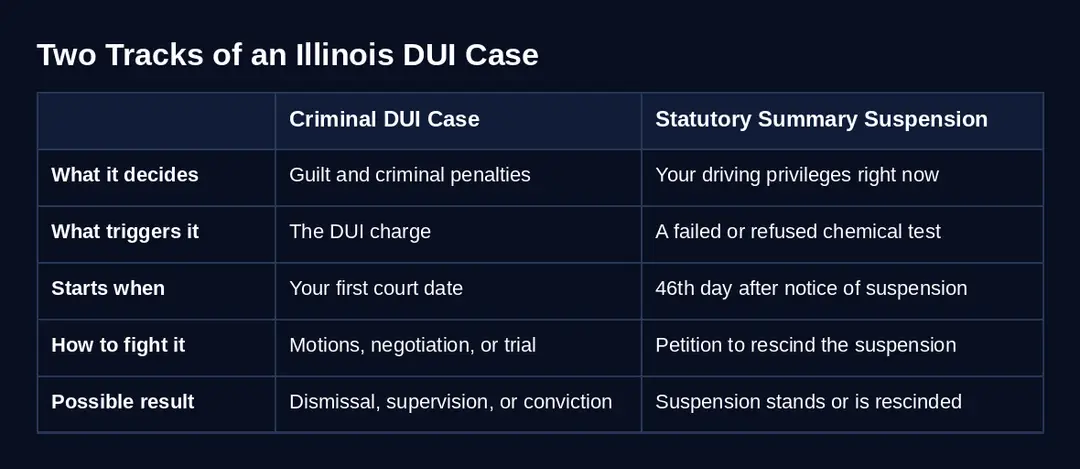
Most people expect the legal system to handle one case. An Illinois DUI arrest actually creates two separate cases that move side by side.
Winning one track does not automatically end the other. That is why your defense needs to address both from day one.
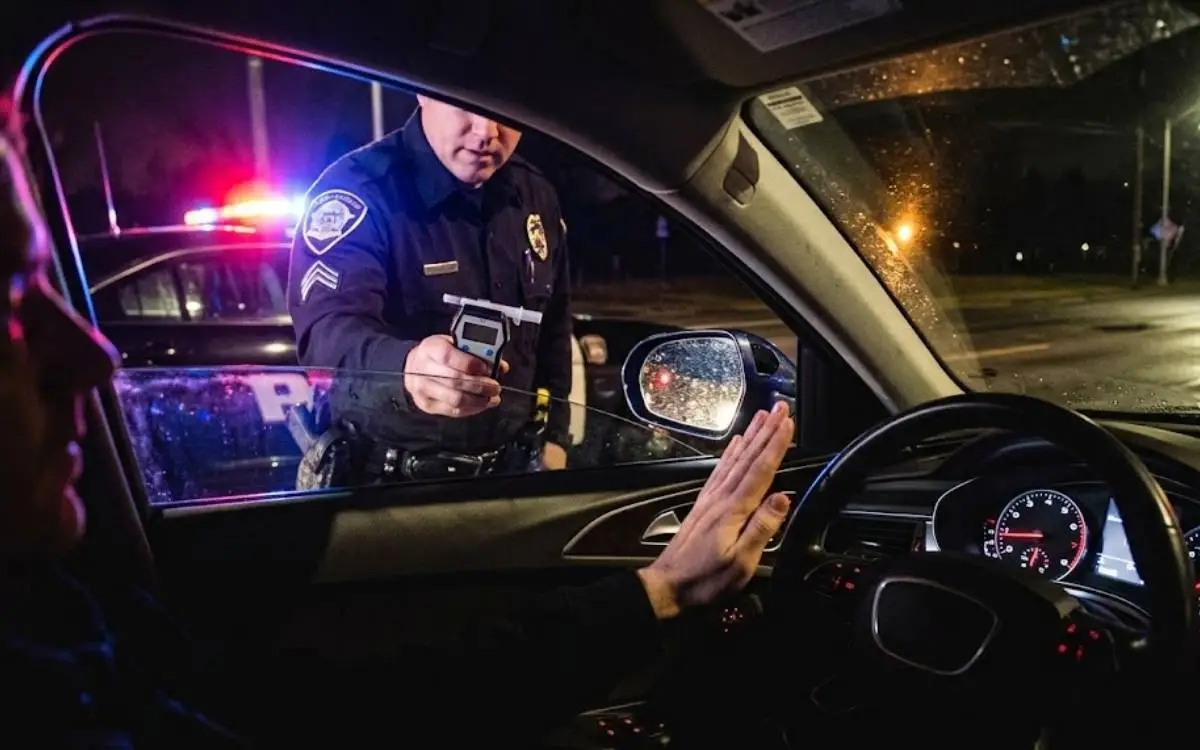
Every Illinois DUI arrest begins with the DUI arrest process on the roadside. What the officer did, and did not do, during those first minutes often shapes the entire case.
An officer needs a legal reason to stop your car. To arrest you, the officer needs probable cause, which means facts that would lead a reasonable person to believe you were driving while impaired.
Officers usually build that probable cause with:
After arrest, Illinois’ implied consent law applies. By driving on Illinois roads, you are deemed to have agreed to chemical testing of your breath, blood, or urine.
The officer chooses the test. A breathalyzer test measures blood alcohol content. A blood test or urine test is more common in drugged driving and other impaired driving cases.
Under 625 ILCS 5/11-501, it is illegal to drive with an alcohol concentration of 0.08 or more. Cannabis has its own limits: 5 nanograms or more of THC per milliliter of whole blood, or 10 nanograms in another bodily substance, within two hours of driving.
You can refuse a breathalyzer test at the station, but refusing a chemical test carries its own license suspension.
Illinois ended cash bail in September 2023 under the Pretrial Fairness Act. Most people charged with a misdemeanor DUI offense are released with a ticket, conditions of release, and a court date.
Keep every document you received. Your ticket lists your court date, and your Notice of Summary Suspension starts the 46-day countdown.
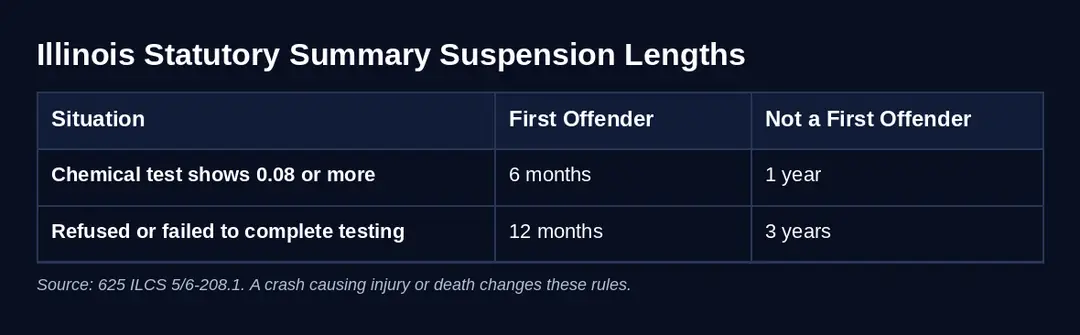
Your license suspension starts on the 46th day after the officer gave you notice of the statutory summary suspension. This happens no matter how your criminal case is going.
The length depends on two things: whether you tested or refused, and whether you count as a “first offender” under Illinois law.
You have 90 days from the notice to ask the court for a hearing to rescind (cancel) the suspension. The court must hold that hearing within 30 days of your written request or your first appearance date.
At this hearing, the judge looks at four narrow questions:
Filing the petition does not pause the suspension. Speed matters, so we work to get this hearing on the calendar fast. Here is how to prepare for your hearing if you have one coming up.
The hearing also locks in sworn testimony from the arresting officer. We use that testimony later in the criminal case.
Many first offenders qualify for a Monitoring Device Driving Permit (MDDP). The permit lets you drive for any purpose, at any time, as long as your car has a Breath Alcohol Ignition Interlock Device installed.
You are not eligible for an MDDP if the arrest involved death or great bodily harm to another person, or if you are under 18.
The criminal case follows its own path. The number of court dates varies by courthouse, judge, and the complexity of your case. Learn more about how long a DUI case takes in Illinois.
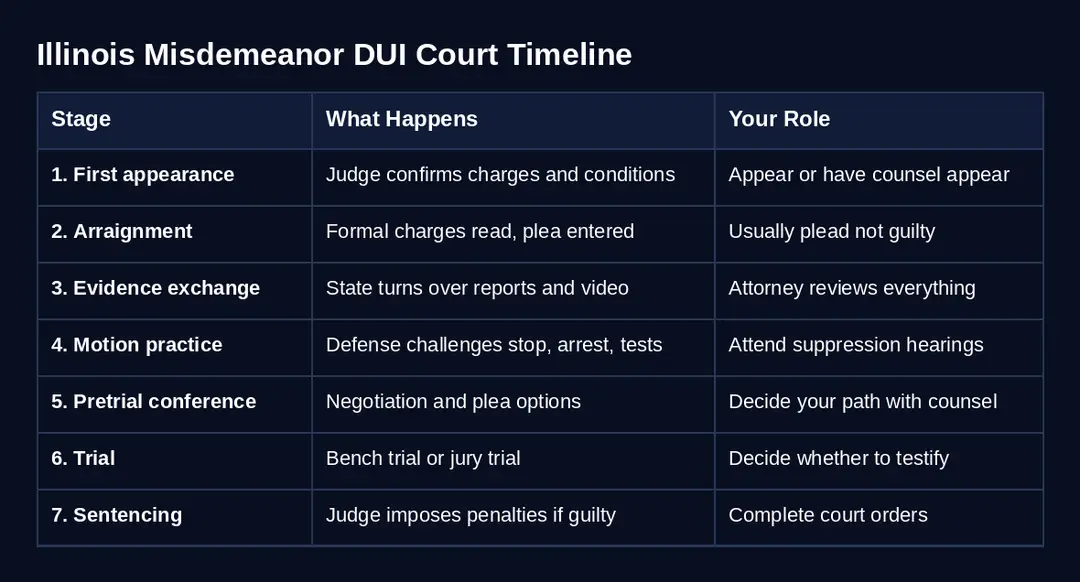
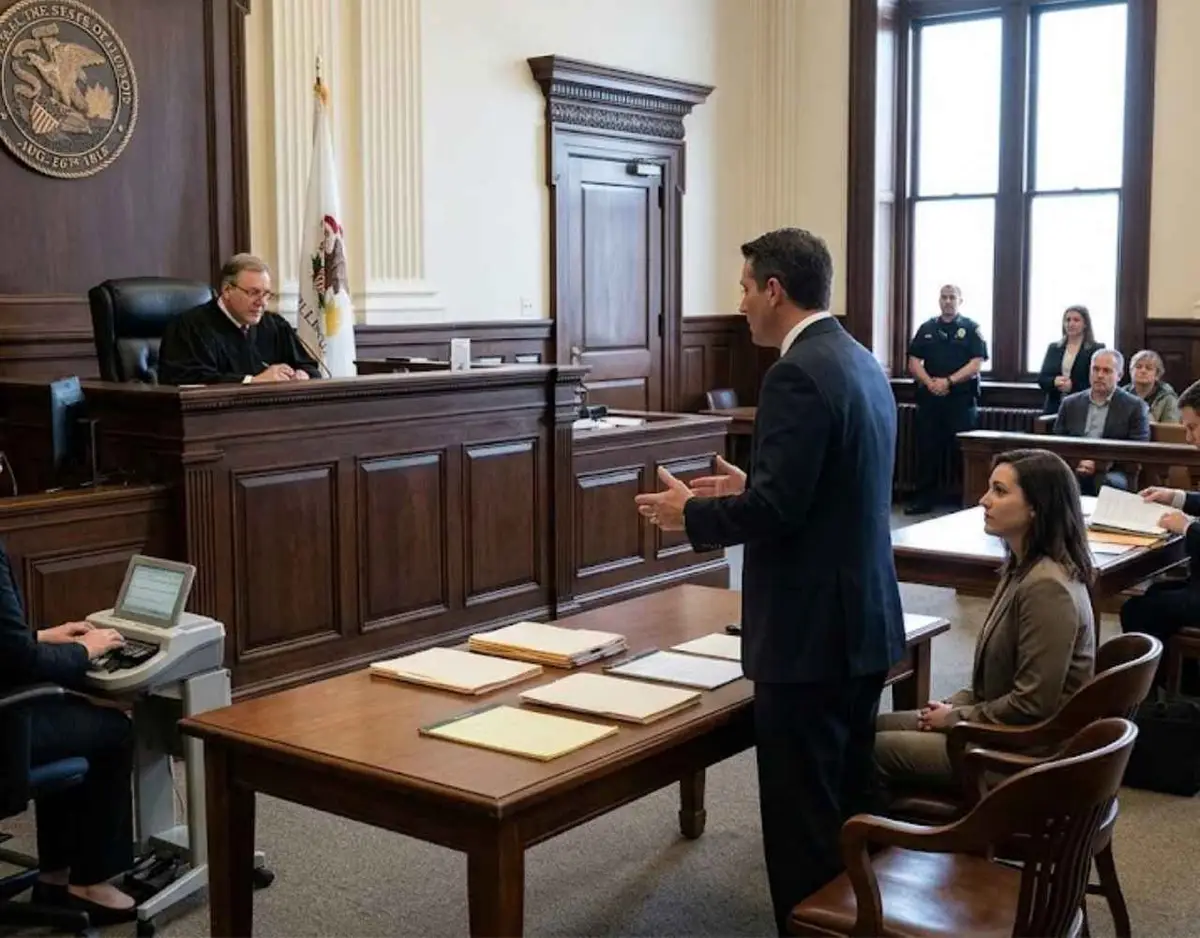
At your first court date, the judge confirms the DUI charges and any release conditions. At arraignment, the formal charge is read and you enter a plea.
Most people plead not guilty at this stage. A not guilty plea keeps every option open while your attorney reviews the evidence.
Next comes evidence exchange, often called discovery. The State hands over what it plans to use against you.
That evidence often includes:
Body-worn camera video often tells a different story than the written report. We compare them line by line.
Motion practice is where many DUI cases change shape. A motion to suppress asks the judge to exclude evidence the police gathered illegally.
Illinois law (725 ILCS 5/114-12) allows a motion to suppress evidence from an illegal search or seizure. The motion generally has to be filed before trial.
At a suppression hearing, your attorney may challenge:
If the judge suppresses key evidence, the State may not have enough left to proceed. Every case is different, and no attorney can promise how a judge will rule.
At a pretrial conference, the prosecutor and defense attorney discuss the case. Sometimes the judge takes part.
Your plea options may include:
You make the final decision. Our job is to give you a clear read on the risks and benefits of each choice.
If your case goes to a DUI trial, you choose between a bench trial (the judge decides) and a jury trial. The State must prove every element beyond a reasonable doubt.
At trial, we cross-examine the arresting officer, challenge the chemical test, and present your side. You have the right to testify and the right to stay silent.
If you are on pretrial release, you can file a written demand for trial. Illinois law then requires trial within 160 days, with some exceptions.
A not guilty verdict ends the criminal case. A guilty finding leads to sentencing.
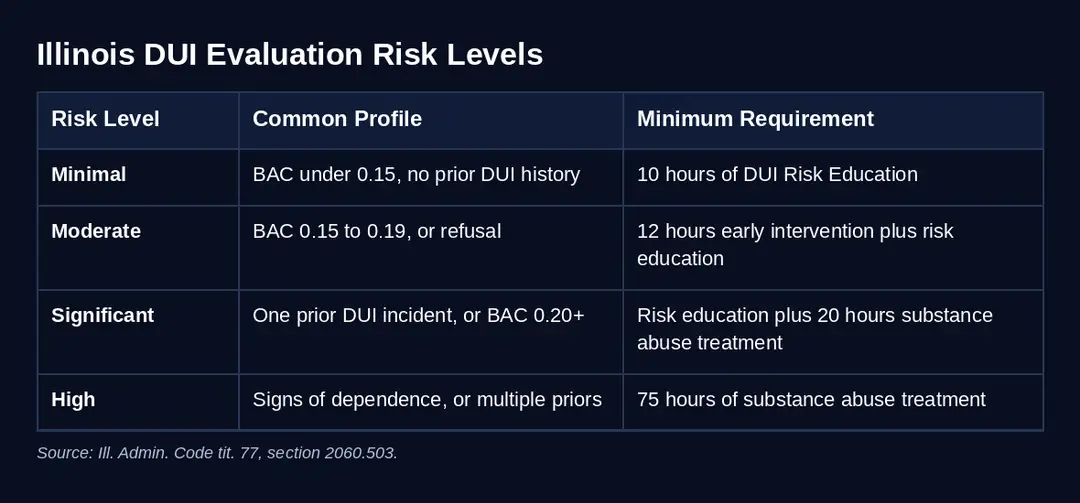
Before sentencing, Illinois requires an alcohol and drug evaluation. At the hearing, the prosecutor presents aggravating factors, and your attorney presents mitigating factors like your work history and steps you have already taken.
A first or second DUI offense is generally a Class A misdemeanor. Penalties depend on your history and the facts of the arrest.
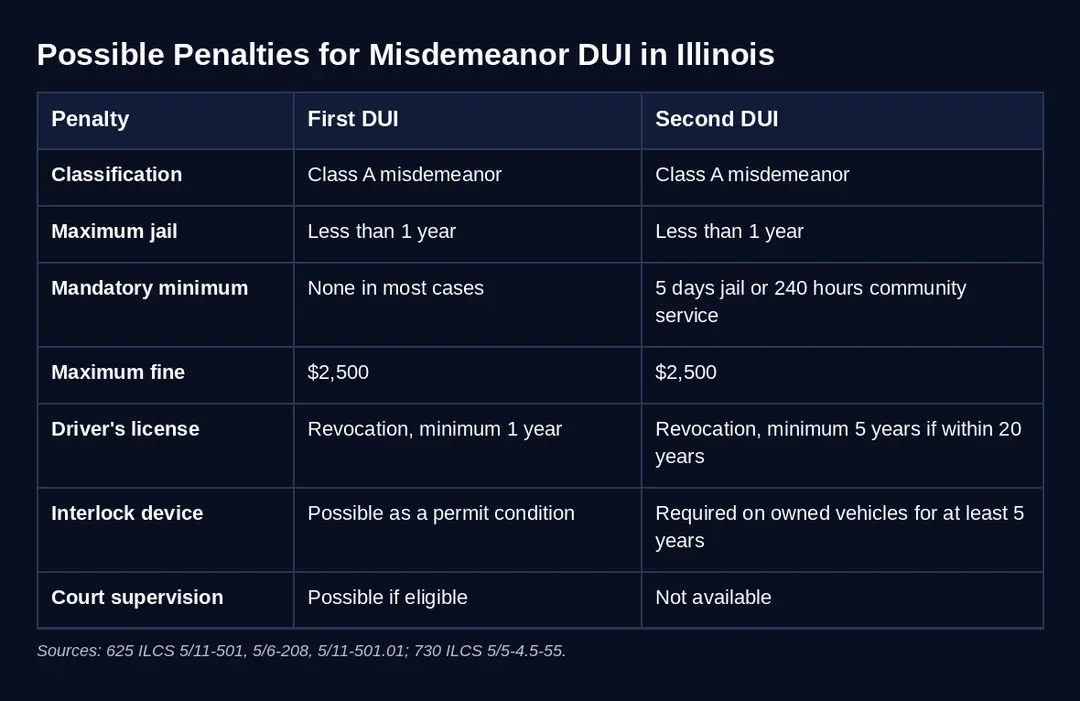
A blood alcohol concentration of 0.16 or more on a first DUI adds a mandatory minimum fine of $500 and 100 hours of community service. Facing a second DUI? The mandatory jail or community service cannot be reduced by the court.
Court supervision is a sentence where the court does not enter a conviction if you complete all conditions. For many first-time drivers, it is the most important result on the table.
Supervision is not available if you have a prior DUI conviction or a prior DUI supervision. It also stays on your record with the Illinois Secretary of State and counts as a prior if you are arrested again.
A licensed evaluator reviews your alcohol and drug use, your blood alcohol content, and your driving history. The evaluator then assigns a risk level.
A DUI conviction reaches well beyond the judge’s order. Common collateral effects include:
Some DUI charges are felonies from the start. Illinois calls this aggravated DUI.
Common triggers include a third DUI offense, a crash causing great bodily harm, or driving on a license revoked for a prior DUI. Felony cases add steps like a preliminary hearing or grand jury, and they carry possible prison time.
If your charge falls into this category, read our guide to felony DUI charges in Illinois.

The Illinois DUI court process rewards preparation. The attorneys who know where a case is weakest are often the ones who used to sit at the prosecution table.
Alex Ktenas served as an Assistant State’s Attorney in Cook County, in both Chicago and Markham. Nick Ktenas prosecuted felony cases in Markham. Lauren Ktenas brings experience as a former Will County Assistant State’s Attorney.
That background shapes how we review every file:
A charge is not a conviction. The right defense depends on the evidence, the court, and your goals.
Your license and your record are on the line right now. Reserve a Priority Case Review with an Illinois DUI defense attorney on our team. Call (312) 800-1626 or reach out online, and let us start building your defense before your first court date.
Usually several months, depending on the courthouse, the motions filed, and whether the case goes to trial.
Yes, though your attorney may appear for you on some dates unless the judge requires you there.
It can happen when key evidence is suppressed, but no attorney can promise that result. An attorney can review your case and explain realistic options.
The suspension is an administrative penalty tied to your chemical test, while a conviction comes from the criminal case and leads to license revocation.
Usually not; it is a Class A misdemeanor unless aggravating factors, like a crash causing great bodily harm, apply.