


If I Don't Take a Breathalyzer, Won't My License Be Suspended?
 10/15/2026

Getting arrested for DUI in Chicago is stressful. It gets more complicated when your license is from another state. Will your home state find out? Do you have to fly back to Illinois for every court date?
Here is the short version. Illinois will handle your DUI charges in its own court system, and the Illinois Secretary of State will very likely notify your home state through interstate communication between state agencies. What happens next depends on your home state’s own laws, and the early deadlines matter more for out-of-state drivers than almost anyone else facing DUI charges in Chicago.
We are a Chicago DUI defense firm staffed entirely by former prosecutors. If you’re sorting out what an Illinois arrest means for your license back home, schedule a free case review before your next deadline passes.
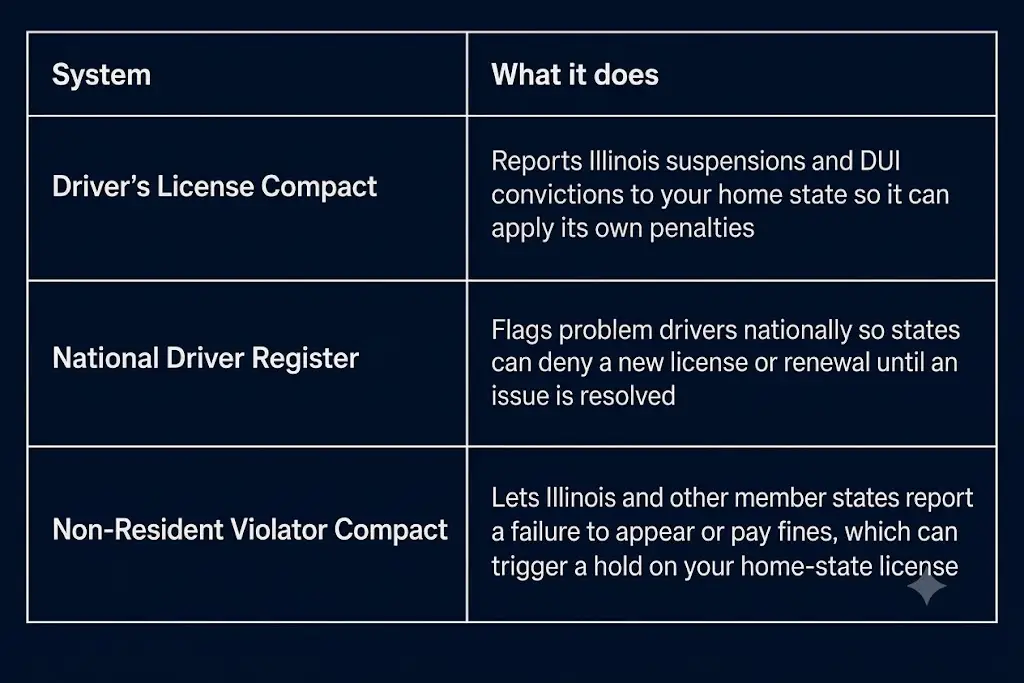
Illinois shares DUI information with other states mainly through two channels:
 What Happens to Your Illinois Driving Privileges
An Illinois DUI arrest triggers two separate tracks:
Illinois operates under an implied consent law: driving on Illinois roads under the Illinois Vehicle Code means you have already agreed to chemical testing if an officer suspects DUI. The summary suspension applies whether you failed chemical testing (a breath, blood, or urine test showing a BAC of 0.08 or higher) or refused it outright.
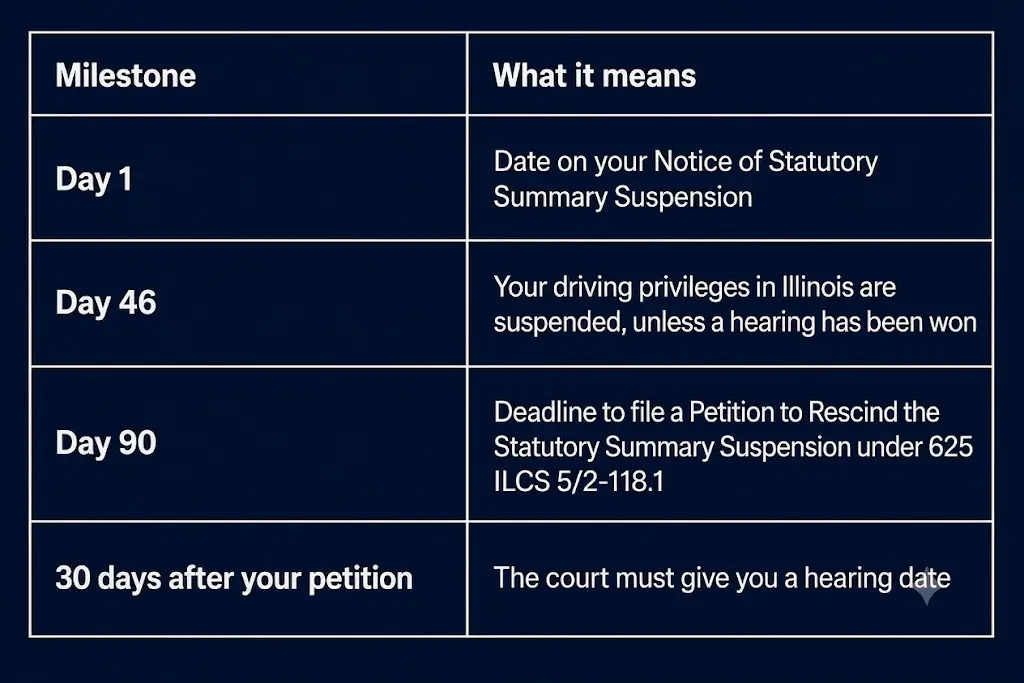 If you hold an out-of-state license, Illinois cannot physically suspend a license it did not issue. What it suspends is your driving privileges within Illinois, and that suspension, along with the underlying arrest, is typically what gets reported to your home state.
Once your home state receives Illinois’s report, state law there, not Illinois law, controls what happens next:
This is also where a common mix-up happens. Fighting the Illinois Statutory Summary Suspension through a Petition to Rescind is not the same thing as license reinstatement:
The same interstate reporting works in reverse for Illinois residents who pick up a DUI in another state, but this article focuses on the scenario we see most often: an out-of-state driver arrested here in Chicago.

The criminal side of an Illinois DUI does not pause because you live somewhere else. Driving Under the Influence, commonly called DUI, is charged in Illinois as a first-offense Class A misdemeanor under the Illinois Vehicle Code (625 ILCS 5/11-501(opens in a new tab)). Court jurisdiction stays in Illinois regardless of where your license was issued, and a Chicago arrest is typically heard in the Cook County court system.
A few things out-of-state clients ask about most:
We never promise a specific result. What we can tell you is that our attorneys spent years as Cook County and Will County prosecutors before switching sides, which means we know how these cases get built from the inside.
Out-of-state CDL holders face an extra layer that has nothing to do with the Driver’s License Compact. Federal regulations treat DUI, including a DUI in a personal vehicle, as a major offense under CDL rules, which can trigger CDL disqualification from commercial driving regardless of your home state or what happens with your personal driving privileges.
If CDL exposure is a concern in your case, that needs to be part of the conversation from day one, not an afterthought once the criminal case is resolved. Read more about CDL DUI defense on our dedicated page.

We are a Chicago DUI defense firm, and every attorney on our team is a former prosecutor: two from Cook County and one from Will County. That means we know the judges, the prosecutors, and the way these cases are actually built in Illinois courthouses, not just the version written down in the Illinois Vehicle Code.
For clients who do not live in Illinois, we focus on two things from the start:
If you were arrested for DUI in Chicago and you are trying to figure out what comes next, reserve a priority case review with our office today, or contact us directly to talk through your timeline.
In most cases, yes. Illinois participates in the Driver’s License Compact and reports DUI-related suspensions and convictions to a driver’s home state, which can then apply its own laws to the situation.
Not necessarily. Some hearings can be handled by your attorney without your presence, depending on the stage of the case and the judge’s requirements. This is something to raise with your attorney immediately after being retained.
For a first offender, failing a chemical test typically results in a 6-month suspension of Illinois driving privileges, while refusing testing typically results in a 12-month suspension. These periods can extend if you have a prior DUI disposition within the last five years.
It can. Federal rules treat a DUI, even in a personal vehicle, as a major offense for CDL purposes, which can lead to disqualification separate from what happens to your standard driving privileges.
Georgia, Massachusetts, Michigan, Tennessee, and Wisconsin are currently outside the compact. Even so, an Illinois DUI can still surface through the National Driver Register or through direct information sharing between agencies, so it should not be treated as a non-issue.